Most contamination risk in pharmaceutical manufacturing has a backstop. A finished product that picks up bioburden during packaging gets caught by a downstream sterilisation step, or the batch fails testing before it ever reaches a patient. Aseptic processing has no such backstop.
The product is exposed, filled, and sealed without any terminal sterilisation to correct for a contamination event that happens during that exposure. This means the room’s environmental integrity is not just a supporting control around sterility assurance. It effectively is the sterility assurance.
Let’s explore what that actually means for how these zones get classified, measured, and monitored.
No Second Chance: Why Aseptic Processing Relies Entirely on Environmental Control
In a terminally sterilised product, a brief contamination event during filling gets neutralised by the sterilisation cycle that follows. In aseptic manufacturing, that cycle doesn’t exist for the finished product. So, every variable the room can control (air quality, pressure direction, personnel movement) has to actively prevent contamination in real time rather than tolerate it and correct later.
This is the reasoning behind why aseptic zones sit under a fundamentally different monitoring philosophy than the rest of a facility, not just a stricter version of the same one.
Grade A and Grade B: What the Classification Actually Requires
EU GMP Annex 1 structures sterile manufacturing environments into four grades, but the real technical distinction that matters for aseptic processing sits between Grade A and Grade B specifically, since these two grades work together to protect the same critical operation from two different directions.
Grade A: The Critical Zone Itself
Grade A is the critical zone immediately surrounding the exposed product, typically under unidirectional airflow at the filling needle or wherever open product handling occurs. It corresponds to ISO Class 5 conditions and carries a particle limit of no more than 3,520 particles per cubic metre at 0.5 microns or larger, and this limit applies identically whether the room is at rest or actively in operation.
That equivalence is the point: a Grade A zone can’t be allowed to degrade once people and equipment start moving, because that’s exactly when the product is exposed.
Grade B: The Background That Has to Hold Grade A’s Integrity
Grade B is the background environment surrounding a Grade A zone, most commonly the gowned aseptic core room itself. At rest, it also holds to the same ISO 5, 3,520-particle limit as Grade A. In operation, that limit relaxes to 352,000 particles per cubic metre, aligning with ISO Class 7.
The gap between Grade B’s at-rest and in-operation limits reflects a specific engineering assumption: personnel and equipment movement in the background area are expected to generate some particle load. However, that load has to stay controlled enough that it never compromises the Grade A zone it surrounds.
Particle Count Limits: What “Compliant” Actually Means
Particle counting sounds like a straightforward measurement, but the current Annex 1 framework treats different particle sizes differently, and getting this distinction wrong is a common source of confusion during classification studies.
The 0.5 Micron Threshold as the Primary Metric
The 0.5-micron particle count is the figure both grades are actually measured against, and it’s tracked in both the at-rest and in-operation states to confirm the room holds its classification under real working conditions, not just when empty.
Why 5 Micron Particles Got Special Treatment in the 2022 Revision
The 2022 revision of Annex 1 removed a fixed numerical limit for particles at 5 microns and larger in Grade A areas, in both states, and in Grade B at rest. However, facilities may still be required to monitor and act on this size where their Contamination Control Strategy or historical trend data indicates it matters.
This wasn’t a relaxation of scrutiny so much as a recognition that macroparticles at this size are genuinely rare in a properly functioning Grade A environment, and a fixed limit on an event that rare produces more false alarms than useful signal.
It does mean facilities need their CCS to explicitly justify how 5-micron particles are handled, rather than defaulting to a number that current guidance no longer specifies.
Why Continuous Monitoring Isn’t Optional in These Zones
Everything above explains what the limits are. What determines whether a facility actually catches a deviation before it becomes a contamination event is how often those parameters get checked, and this is where Grade A and B genuinely diverge from lower grades rather than just running a stricter version of the same monitoring cadence.
Differential Pressure as a Continuous Requirement
Non-viable particle counts require continuous monitoring in Grade A and Grade B specifically, while lower grades can rely on periodic sampling. The same logic applies to differential pressure across critical room-to-room cascades.
A Grade A to Grade B pressure differential has to be tracked continuously, because a brief pressure reversal during a door event or an HVAC fault can pull contaminated air into the critical zone in a matter of seconds, well before a periodic check would ever catch it.
Personnel and Viable Monitoring Tied to Grade
Viable particle monitoring, covering active air sampling, settle plates, contact plates, and operator glove prints, also scales in frequency according to grade, with the highest-risk zones requiring the most frequent and most rigorous sampling regime.
Personnel themselves are the dominant contamination source in most aseptic operations. This is why glove and gowning checks sit alongside environmental readings as part of the same monitoring discipline rather than a separate quality activity.
What This Looks Like in Practice
Translating this regulatory structure into an actual monitoring setup means the hardware has to match the continuous cadence the grade demands, not just the parameter list.
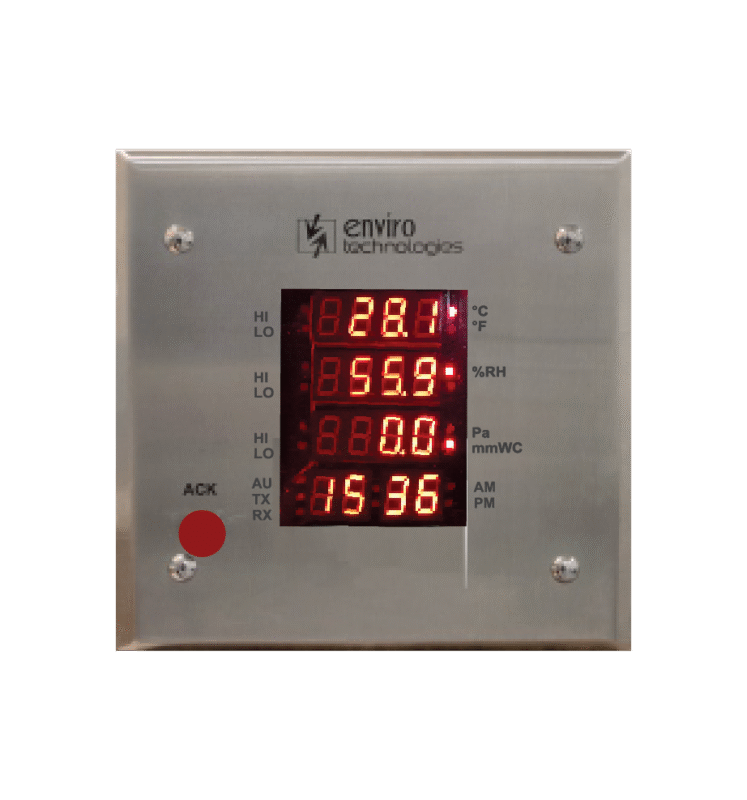
For differential pressure and environmental readings, enviroDPMS provides continuous, real-time temperature, humidity, and pressure monitoring at the point of measurement, feeding alarm notifications the moment a Grade A to Grade B cascade drifts rather than waiting for the next scheduled reading.
Since personnel movement is the primary contamination vector in these zones, access into Grade A and B areas is typically governed separately through biometric readers like BioSLIM, which ties entry to a verified individual rather than a shared credential, paired with smartXS NG plus controllers managing the interlock sequencing between airlocks.
Environmental data and access records both feed into Enviro Unisoft, giving QA a single, continuous, aseptic area environmental monitoring record rather than separate logs that need to be reconciled manually during a deviation investigation.
A Checklist for Aseptic Zone Monitoring
- Continuous, not periodic, particle and pressure monitoring confirmed specifically for Grade A and Grade B zones, distinct from the cadence used elsewhere in the facility.
- At-rest and in-operation classification data on file for both grades, since a Grade A zone’s limit doesn’t relax between the two states.
- A documented CCS position on 5-micron particle monitoring, rather than assuming the removed fixed limit means the parameter can be ignored.
- Personnel access tied to verified identity, not shared credentials, for entry into any Grade A or B zone.
- Environmental and access data consolidated into one auditable record, giving investigators a complete view of the data they need to assess a deviation.
Conclusion
The reasoning traces back to one structural fact: aseptic processing has no terminal sterilisation step to catch a mistake, so the room’s environmental integrity has to carry the full weight of sterility assurance on its own.
That’s why Grade A and Grade B classifications hold their particle limits in both states rather than relaxing when the room is active, why differential pressure and particle counts run continuously instead of on a periodic schedule, and why personnel access gets tied to verified identity rather than a shared card.
None of these requirements is arbitrary strictness layered onto aseptic zones for its own sake. Each one exists because there’s no second chance downstream if it fails, which is exactly what makes continuous aseptic area environmental monitoring the baseline these zones operate under, not an enhancement on top of it.